Every FTX claim sits in a class. The class is not a label you choose - it is assigned by the FTX Recovery Trust based on what kind of claim you hold and which FTX entity it is against. And it matters more than almost anything else, because the class is what sets the recovery percentage.
When a creditor asks Qredax "how much is my claim worth," the first question back is usually "what class is it." A Class 5A claim and a Class 7 claim of the same face value do not recover the same amount, so they do not carry the same offer.
A claim may appear in the debtor’s schedules, a filed proof of claim, or both. Its class determines how it is treated under the Plan; its allowance status is a separate question. U.S. Courts: Chapter 11 claims.
This guide explains the main FTX claim classes - Class 5A, Class 5B and the Class 7 convenience class - what determines which one your claim falls into, why class drives recovery, and which classes Qredax buys.
Key facts
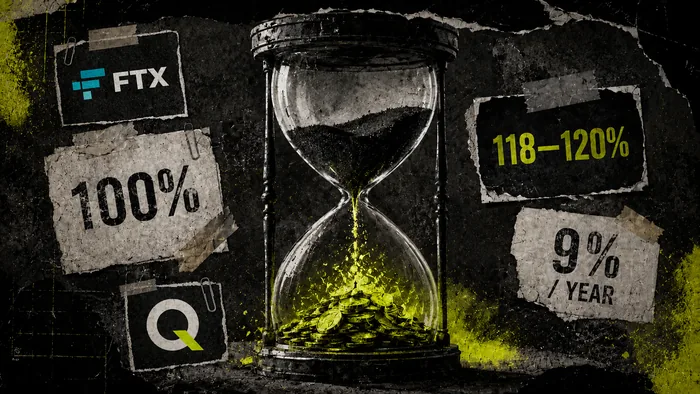
- FTX's 31 July 2026 distribution took Class 5A (Dotcom customer) claims to 105% cumulative, after an incremental 9% (FTX release, 17 July 2026).
- The same 31 July 2026 round took Class 5B (U.S. customer) claims to 105% cumulative, with a 5% payment (FTX release, 17 July 2026).
- Classes 6A (general unsecured) and 6B (digital asset loan) reached 103% cumulative with the 31 July 2026 round's 3% payment (FTX release, 17 July 2026).
- FTX lists Class 7 convenience claims at a cumulative 120% as of the 31 July 2026 round (FTX release, 17 July 2026).
- The plan's Consensus Rate for postpetition interest is 9.0%, or a lower rate the court approves (Plan, D.I. 26404-1, s. 2.1.39).
- The court-approved conversion table used to value crypto claims prices 1 BTC at $16,871.63 (Digital Assets Conversion Table, D.I. 7090-1).
What a Claim Class Is
A bankruptcy plan does not treat every creditor identically. It sorts claims into classes, and each class has its own treatment - its own recovery percentage and its own distribution mechanics. The FTX plan of reorganisation, confirmed in the Delaware bankruptcy case, does exactly this.
“As required by section 1122(a) of the Bankruptcy Code, each Class of Claims and Interests contains only Claims or Interests that are substantially similar to the other Claims or Interests within that Class.”
- Findings of Fact, Conclusions of Law and Order Confirming the Second Amended Joint Chapter 11 Plan of Reorganization of FTX Trading Ltd. and Its Debtor Affiliates, D.I. 26404, October 8, 2024
The court confirmed that each class groups only similar claims; your class decides which recovery terms apply to you.
Your class is determined mainly by two things: the type of claim you hold (a customer claim for assets you had on the exchange, versus a general unsecured claim) and the FTX entity the claim is against. FTX was not one company; it was a group, and the international exchange and the US exchange were separate legal entities with separate customer pools.
You do not select your class. The Trust assigns it, and it appears against your claim in the Kroll claims system. If you have a claim number, the class is already attached to it.
FTX Claim Classes and What They Recover
The figures below are cumulative distributions announced for July 31, 2026 in the FTX announcement of July 17, 2026, subject to eligibility. They are percentages of allowed claim amounts, not purchase offers, remaining payments or confirmation of what an individual creditor received.
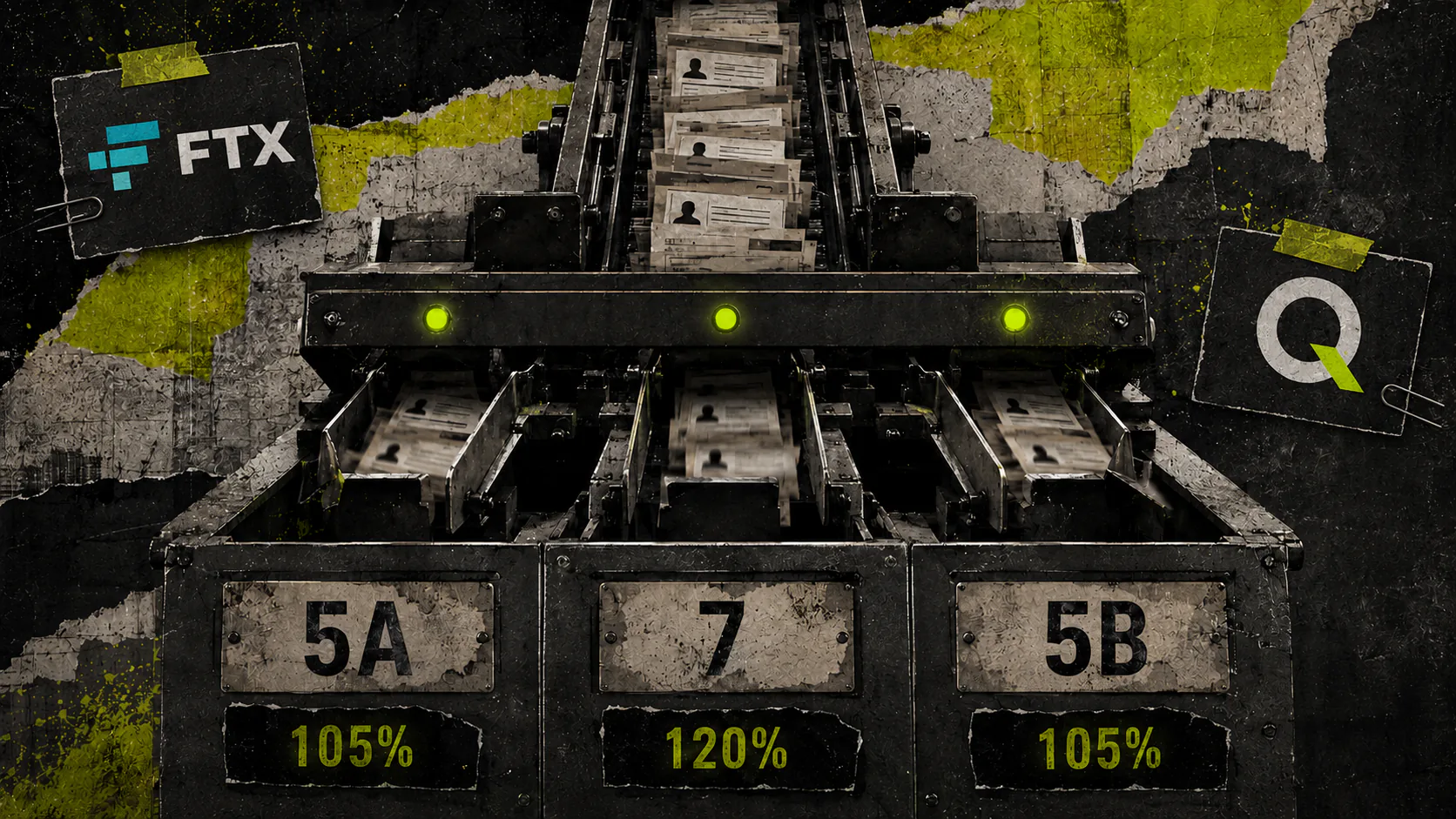
| Class | Who it covers | Cumulative distribution announced for July 31, 2026 |
|---|---|---|
| Class 5A | Dotcom customer claims - the international FTX exchange | 105% |
| Class 5B | US customer claims - the FTX.US exchange | 105% |
| Class 6A | General unsecured claims | 103% |
| Class 6B | Digital asset loan claims | 103% |
| Class 7 | Convenience class - claims of $50,000 or less by adjudicated value before interest | 120%, including interest |
Class 6A (general unsecured claims) and Class 6B (digital asset loan claims) each had an announced cumulative distribution of 103% for the July 31, 2026 round. These classes sit alongside the customer classes.
Two things stand out. First, every one of these classes is recovering a high percentage - the FTX estate recovered far more than early headlines suggested. Second, the headline percentages over 100% are not a profit on your original deposit. Recovery is calculated on the petition-date value of your claim - its value on November 11, 2022, the date FTX filed for bankruptcy - not on what those assets would be worth at today's crypto prices.
Class 5A - Dotcom Customers
Class 5A covers customer claims against the international FTX exchange, often called "Dotcom." Most creditors outside the United States hold a Class 5A claim, because the international exchange is where they had accounts.
FTX announced a 9% incremental distribution for eligible Class 5A claims in the July 31, 2026 round, bringing the announced cumulative distribution to 105%. This is a dated cumulative figure, not a forecast of final recovery or an amount still due on every claim.
Because 5A is the largest customer class and recovers strongly, it is the class most claim buyers focus on, and it is the core of what Qredax buys.
Class 5B - US Customers
Class 5B covers customer claims against FTX.US, the separate American exchange entity. FTX announced a 5% distribution for eligible Class 5B claims in the July 31, 2026 round, bringing the announced cumulative distribution to 105%.
Most creditors outside the US will not hold a 5B claim, because they generally used the international exchange rather than the US one. If your claim is in 5B, it means your account was with the FTX.US entity specifically.
Class 7 - the FTX Convenience Class
Class 7 is the convenience class. A convenience class is a common feature of large bankruptcy plans: it groups together smaller claims under a set dollar threshold and pays them on simplified, faster terms, so the estate is not running full distribution mechanics for a very large number of small balances.
“"Dotcom Convenience Claim" means (a) any Dotcom Customer Entitlement Claim that is Allowed in an amount equal to or less than $50,000”
- Second Amended Joint Chapter 11 Plan of Reorganization of FTX Trading Ltd. and Its Debtor Affiliates, D.I. 26404-1, October 8, 2024
If your Dotcom claim was allowed at $50,000 or less, it sits in the convenience class, which FTX lists at 120%.
The FTX convenience class is treated at a 120% recovery, including interest. The threshold is $50,000 or less - a claim whose adjudicated value, before interest, is $50,000 or under falls into the convenience class. The trade-off for a Class 7 holder is straightforward: a defined, relatively quick payout, at the cost of not sharing in any further upside the larger customer classes might see.
A holder with a claim above $50,000 could elect into the convenience class by capping their claim at $50,000 - accepting the $50,000 ceiling in exchange for the simplified 120% treatment. Whether that made sense depended on the individual claim.
The convenience class has subclasses by entity: 7A for Dotcom convenience claims, 7B for US convenience claims, and 7C for General Convenience Claims, i.e. general unsecured claims allowed at $50,000 or less. Each carries the same convenience treatment across its claim grouping.
Why Class Drives the Offer You Get
When Qredax - or any claim buyer - prices a claim, the starting point is what the claim will recover. A buyer is purchasing the right to future distributions, so the recovery percentage of the class sets the ceiling on what the claim is worth.
A clean Class 5A claim recovers strongly and predictably, which is why it attracts the strongest offers. On the Qredax pricing tiers, a clean Class 5A claim is offered at up to 95% of face value - the amount you receive, settled in USDT, today, without waiting on the remaining Trust distributions. A Class 7 claim is offered at up to 70% of face value.
The gap between those two tiers is not a comment on the quality of a Class 7 claim. It reflects timing and the structure of each class - how distributions are sequenced and how the recovery profile is expected to play out. For a fuller breakdown of how an offer is built, see how much an FTX claim is worth in 2026.
Class Is Not the Only Thing That Affects Price
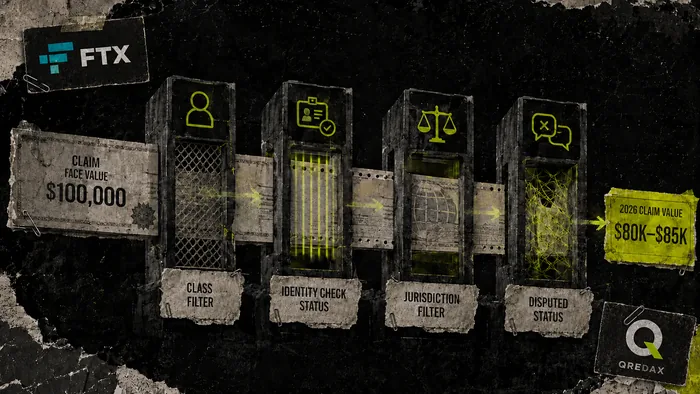
Class sets the recovery ceiling, but two claims in the same class do not always carry the same offer. Other factors sit on top of it.
- KYC status. A claim where identity verification (KYC) has stalled is harder to transfer, and that is priced in. See why KYC fails for CIS creditors.
- Dispute status. A claim the Trust has objected to or marked disputed carries extra uncertainty, and the offer reflects that risk.
- Jurisdiction. Where the creditor is resident affects how cleanly a transfer can be completed.
- Documentation. A claim with complete, consistent records moves faster than one with gaps.
So the class tells you which recovery tier your claim sits in. The condition of the claim - KYC, disputes, paperwork - decides where inside that tier the offer lands.
Which Classes Qredax Buys
Qredax buys claims of all classes: 5A, 5B, 6A, 6B and 7.
The most useful first step is simply to send your claim number, the class shown against it in Kroll, and your jurisdiction. From those three details, Qredax can confirm whether the claim is one it buys and put a firm number against it. If you are unsure of your class, the claim number alone is enough to look it up.
Check what your claim is worth
Enter your customer code - we will show an estimate that accounts for class and KYC status. Free, no obligation.
Open the calculatorFAQ
Find out what your class is worth.
Send us your claim number, the class shown in Kroll, and your jurisdiction. We respond with a firm offer within one business day. An NDA covers your details before any documents change hands, and there is no obligation to accept.
Sell your FTX claim