What happened to FTX
If your money is stuck on FTX, you are not alone — so is the money of millions of other people, including customers in dozens of countries. The exchange collapsed in a matter of days: customer funds were not on the exchange at all, they had been moved to an affiliated company. The bank run was halted, on November 11, 2022 FTX filed for bankruptcy, and user funds were frozen. Here is what actually happened and what it means for your claim.
The short answer to "what happened to FTX": the exchange spent customer money, could not return it on demand, and declared itself bankrupt. From that point on, the fate of the funds is controlled not by the exchange but by a U.S. bankruptcy court.
The scale was enormous: the shortfall ran into billions of dollars, and the people affected were millions of customers worldwide. It is important to understand that this was not a "hacker theft" but the company's own misuse of customer funds. So the money did not vanish without a trace: a large share of the assets has been found and gradually returned to the common pool used to pay creditors.
What Chapter 11 Means in the FTX Bankruptcy
FTX filed for Chapter 11 bankruptcy. This process lets a company address creditors’ claims through a court-approved plan. It does not mean the exchange has to reopen: a Chapter 11 plan can also provide for liquidation. See the U.S. Courts guide to Chapter 11.
What Is an FTX Bankruptcy Claim?
An FTX bankruptcy claim is a creditor’s right to seek payment from an FTX company in the bankruptcy case. For a customer, it concerns the funds owed after the exchange stopped withdrawals.
FTX claims differ by debtor, class and status. A claim number identifies a record; it does not by itself mean the amount has been finally accepted in the case (“allowed”). The Bankruptcy Code includes disputed and conditional claims. See our guide to FTX claim classes for the plan categories.
Claim amount and sale price are different. The amount recorded or allowed in the case is separate from what a buyer offers for the rights you transfer. A private valuation does not verify your official claim status.
What Can You Do With an FTX Claim?
- Check your status. For U.S. customer claims, open the official FTX Customer Claims Portal and review your claim record and any outstanding steps. Qredax does not operate the portal.
- Compare offers. Our FTX claim value guide explains what to look at when assessing a sale price.
- Consider selling. To sell your FTX claim, request an individual offer from Qredax. A sale depends on the claim review and agreed contract terms.
Will FTX money come back — and when
The question every holder asks: "will FTX money come back and when are the FTX payouts?" The good news — payouts are no longer a promise but a fact. The payer is not the exchange itself but the FTX Recovery Trust: a structure created under the bankruptcy plan specifically to settle with creditors. There is a detailed piece on what the FTX Recovery Trust is.
How much has already been paid
Payouts go out in distributions (waves) starting in early 2025:
- Distribution 1 — about $1.2 billion, February 2025 (small claims, the Convenience Class, went first);
- Distribution 2 — about $5 billion, May 30, 2025;
- Distribution 3 — about $1.6 billion, September 30, 2025;
- Distribution 4 — about $2.2 billion, March 31, 2026.
- Distribution 5 — about $900 million, July 31, 2026.
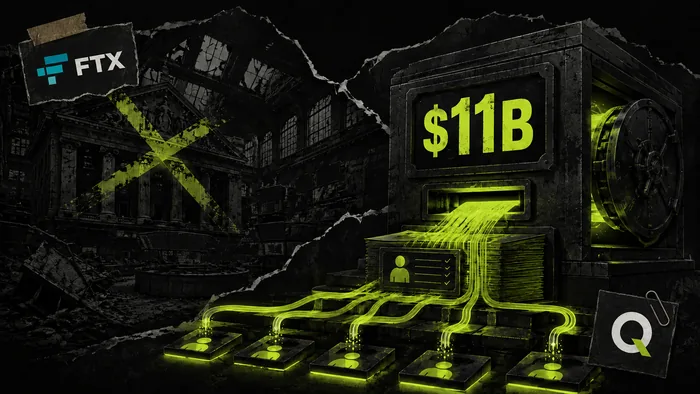
In total, roughly $11 billion has already gone back to creditors. The fifth distribution took place on July 31, 2026 (record date June 16, 2026); the Recovery Trust distributed approximately $900 million. The full timeline is in our FTX payout schedule for 2026.
How much each class gets
How much actually comes back depends on the claim class. Cumulatively, as of today:
| Class | Who | Recovery |
|---|---|---|
| 5A | Dotcom (international) customers | ~105% now, projected ~118-120% |
| 5B | U.S. customers | 100% |
| 6A / 6B | Other claims | 100% |
| 7 | Convenience — small, under $50k | 120% |
Don't read the table as a ladder where the smaller the class, the more it gets. The small convenience claims (Class 7) were closed out first and already include interest, so they show 120%. Class 5A — the Dotcom group, where almost all non-US holders sit — has been paid about 105% of principal so far, but its projected total is also around 118-120%: it earns the same 9% annual interest the plan accrues from the bankruptcy date, November 11, 2022 (the so-called Consensus Rate), only it is paid out in stages across several distributions. So the large classes are expected to recover on a par with the small ones — the plan's average recovery is around 119% — just later. The 118-120% is the Trust's projection, an estimate rather than a guarantee.
The catch: amounts are priced at November 2022
A claim's size is fixed in dollars at the prices on the bankruptcy date — November 2022, not at today's rate. If you held, say, 1 BTC worth ~$16,000 then, the register shows ~$16,000 — even if bitcoin now trades far higher. This is creditors' main grievance: on paper it is "100%+", but measured in today's crypto it is noticeably less than before.
What happened to FTX's founder
FTX's founder was convicted of fraud and on March 28, 2024 sentenced to 25 years in U.S. prison. This no longer affects the repayment process itself: the payouts are run by the independent administrator and the FTX Recovery Trust, not the exchange's former leadership.
The U.S. Court of Appeals for the Second Circuit denied the appeal on June 12, 2026 (US v. Bankman-Fried, No. 24-961) and issued its mandate on August 4, 2026. A petition to the U.S. Supreme Court is still possible, but it would not change the distribution process.
Why the money comes back over years, not at once
Many people are frustrated that payouts arrive in waves spread across 2025–2027 rather than in one go. The reason is that FTX's assets were scattered and illiquid: not dollars sitting in an account, but equity stakes in startups (including AI companies), real estate, tokens, and lawsuits to claw back money from parties the exchange had overpaid. All of this first has to be found, valued, sold or litigated — and only then distributed to creditors. Each distribution is a fresh batch of recovered, court-approved money. That is why the process moves in waves, and when the FTX payouts reach you specifically depends on your claim class and on the next distribution being ready.
If you hold an FTX claim in a restricted jurisdiction
Theory is fine, but for holders in Russia, Belarus and Ukraine payouts often hit a practical wall: KYC verification in the Kroll system stalls or is rejected for non-U.S. passports, and access to the services that distribute the money is restricted. What to do about it is covered in our guide on KYC problems for CIS creditors.
If waiting several years for full repayment is not an option, a claim can be sold now for a clean USDT amount — as set out for holders from Russia, Belarus and Ukraine. To see what your claim is worth today, use the free valuation.
What to know before selling a claim
If you are weighing a sale, keep a few things in mind. First, the claim amount is fixed at November 2022 prices: that is the base both for the future payout and for any sale price, and today's crypto rate no longer changes it. Second, for creditors outside the US the key risk is KYC: if verification at Kroll stalls or is rejected, full repayment can take several years, which is exactly why many people choose to sell the claim now rather than wait for every distribution. Third, a claim sale is done through an assignment-of-claim agreement, and this is where to be careful: check who you are transferring the claim to and on what terms, whether there is a clear written contract, and whether the transfer is registered in the official Kroll docket. A legitimate deal asks for no upfront payment and never asks you to send money to personal wallets. The same factors that drive the payout — claim class, KYC status, jurisdiction — also set what your claim is worth on the market today. So a sensible first step is simply to learn its current valuation.
Find out what your FTX claim is worth
Enter your claim details — a valuation usually comes back within one business day. You pay us nothing, no obligation.
Get a QuoteFAQ
Will FTX customers get their money back?
Yes — repayment is already underway. By mid-2026 creditors had been paid roughly $11 billion across five distributions, and payouts continue. The exact percentage depends on your claim class.
When is the next FTX payout?
Five distributions have been made, the latest on July 31, 2026. The fifth distribution took place on July 31, 2026 (record date June 16, 2026); the FTX Recovery Trust distributed approximately $900 million.
How much comes back — 100% or less?
It depends on the claim class. The main classes are 5B at 105% and 6A/6B at 103%, and the small convenience claims (Class 7) are at 120%. Class 5A, the Dotcom group, has been paid about 105% of principal so far, with a projected total of around 118-120% once the same 9% annual interest is added — it is simply paid in stages. The plan's average recovery is around 119%, with a ceiling up to 140% for some classes. Important: every percentage is measured against the dollar value at November 2022, so for anyone who held crypto on FTX, even 100%+ is worth less in today's terms.
What is an FTX claim?
An FTX claim is a creditor’s right to seek payment in the FTX bankruptcy. Its official status and amount are separate from the price a buyer may offer. A claim number alone does not confirm that the amount has been allowed.
Can I sell an FTX claim from Russia or the CIS?
Yes. A claim can be assigned to a buyer under a contract and paid out in USDT without waiting for every distribution — useful for holders whose KYC is stuck.