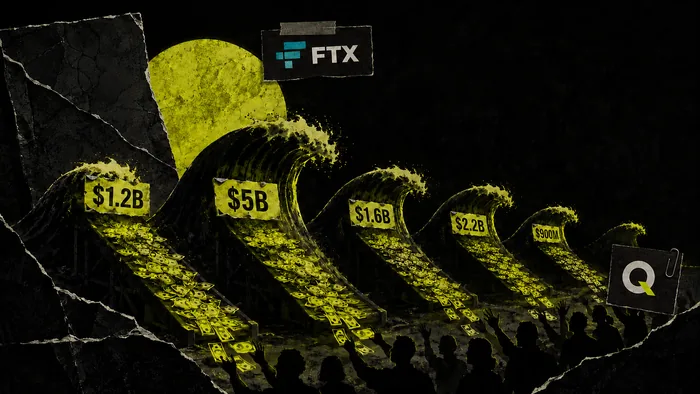
The FTX estate is paying, and paying above face value. Class 5A claims have reached 105% of their petition-date amount. More than ten billion dollars has moved.
Across much of the Arab world the figure is still zero.
Egypt. Saudi Arabia. Kuwait. Qatar. Lebanon. Iraq. Morocco. Algeria. Tunisia. Libya. Syria. Sudan. Somalia.
None of these creditors was rejected. Their claims are valid, allowed, and counted in the same pool as everyone else's. The money simply has no route to reach them.
This guide explains where the process breaks, why the region splits the way it does, what FTX has actually said about it, and what a blocked creditor can still do.
Key facts
- As of 1 October 2026, FTX lists Saudi Arabia, Egypt, Qatar, Kuwait, Iraq and Morocco among jurisdictions not eligible for distributions (FTX DSP page, updated 2 Oct 2026).
- FTX says holders who do not onboard with a provider within six months of the 31 July 2026 distribution date may forfeit their distributions (Distributions Dashboard FAQs, updated 13 Sept 2026).
- Payoneer pays fiat into local bank accounts, but only for individual distributions above $50 (FTX DSP page, updated 2 Oct 2026).
- The Trust's 2 July 2025 motion named 49 potentially restricted jurisdictions, worth about 5% of projected allowed claims (Motion, D.I. 31148).
- After a court hearing on 23 October 2025, the Trust filed notice withdrawing that motion (Notice of Withdrawal, D.I. 33439, 3 Nov 2025).
The Wall Is at Step 8
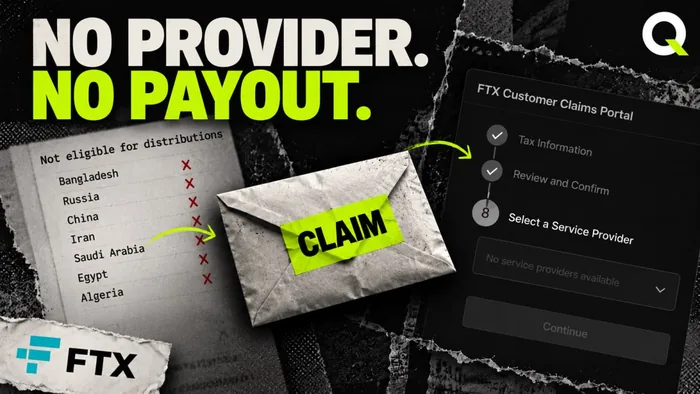
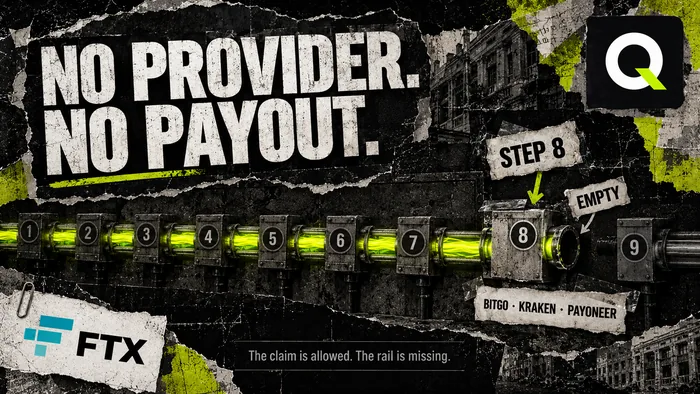
To receive a distribution, a creditor works through a sequence in the FTX Customer Portal: identity verification, tax documentation, then the selection of a distribution service provider. That last step is where it stops.
“As of October 1, 2026, the following jurisdictions are not eligible for distributions and creditors resident in those jurisdictions cannot select Distribution Service Providers in the FTX Customer Portal.”
- General Information on Distribution Service Providers, October 2, 2026
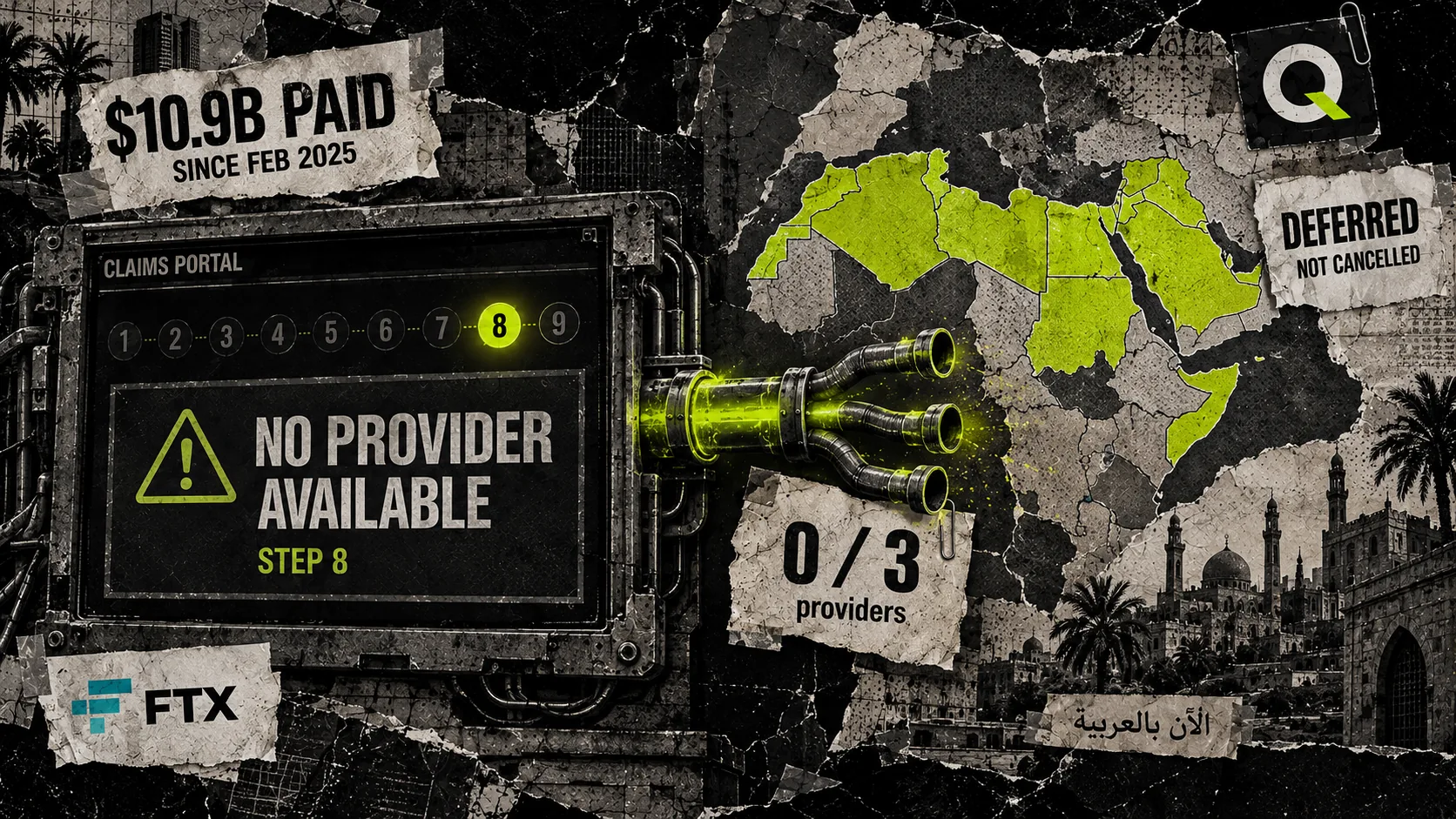
Residents of the listed countries, including Saudi Arabia, Egypt and Qatar, cannot choose a provider at Step 8, so the portal cannot pay them.
FTX pays through three partners: BitGo, Kraken and Payoneer. FTX's page for each lists the jurisdictions it supports as of October 1, 2026 (pages updated October 2, 2026). A creditor can only select a provider that serves their country.
In those thirteen countries, none of the three does. The dropdown at Step 8 is empty. There is nothing to choose, so the process cannot continue.
The Region Is Split, and Not Along the Line You Would Expect
The blocked list is not "the Arab world." Nine Arab League members have working access today.
| Access | Countries |
|---|---|
| All three providers | United Arab Emirates, Bahrain, Jordan |
| Two providers | Oman, Yemen, Comoros, Mauritania, Djibouti |
| One provider | Palestine |
| No provider | Egypt, Saudi Arabia, Kuwait, Qatar, Lebanon, Iraq, Morocco, Algeria, Tunisia, Libya, Syria, Sudan, Somalia |
Set those two groups against each other and the pattern refuses to resolve. The UAE and Bahrain are served; Saudi Arabia and Kuwait are not. Jordan is served; Lebanon is not. Oman is served; Qatar is not.
These are neighbours with comparable banking systems and comparable regulatory postures. Yemen, a country in the middle of a humanitarian catastrophe, has two providers. Qatar has none.
Sanctions do not explain it. Syria and Libya carry restrictions that make the outcome unsurprising, but Morocco, Tunisia, Jordan and Kuwait do not, and they land on opposite sides of the line. Wealth does not explain it either.
Why the Line Falls Where It Does
There is a regulatory landscape underneath this. The UAE and Bahrain built licensing regimes for virtual assets early: VARA in Dubai, FSRA in Abu Dhabi, central bank licences in Bahrain. Custodians had somewhere to stand. Saudi Arabia's central bank has instructed banks not to process unlicensed crypto transactions. Qatar's financial centre banned virtual asset activity in 2020.
“The regulations of concern in the Potentially Restricted Foreign Jurisdictions vary, but generally prohibit a person or entity from engaging in any activity related to digital assets, including trading in cryptocurrency or paying the proceeds of cryptocurrency to residents in the jurisdiction.”
- Motion of the FTX Recovery Trust for Entry of an Order in Support of the Confirmed Plan Authorizing the FTX Recovery Trust to Implement the Restricted Jurisdiction Procedures in Potentially Restricted Foreign Jurisdictions, D.I. 31148, July 2, 2025
In its July 2025 motion, later withdrawn, the Trust named local crypto bans as its concern about paying residents of restricted countries.
That is a plausible story, and it may be the right one. But it is inference, not explanation, and one detail cuts against it.
Payoneer does not touch crypto. It pays in fiat, by bank transfer, and it operates commercially in Saudi Arabia, Qatar and Kuwait today. For FTX distributions it excludes all three.
Whatever is happening there is not about crypto licensing. It looks like compliance requirements imposed further up the chain, by the correspondent banks that clear dollars for the estate, and nobody involved has said so publicly.
The honest answer is that we do not know. The three providers publish which countries they serve. None of them publishes why. FTX has not explained the gaps, and the public documents do not contain the reasoning.
What FTX Has Actually Said
Two things, both official, both narrow.
The first is a status. As of October 1, 2026, FTX names 44 jurisdictions whose residents cannot select a distribution service provider in the Customer Portal. Thirteen of them are Arab countries. The page says: "The FTX Debtors are continuing to assess eligible jurisdictions, and the FTX Customer Portal will be updated in due course for any additional eligible jurisdictions."
The second is a warning that cuts the other way. A holder of an allowed claim who does not successfully onboard with a provider within six months of July 31, 2026 may forfeit the right to distributions on that claim.
Read those together and the position is uncomfortable. Onboarding requires a provider. Thirteen countries have no provider. The clock is running anyway.
There is one more moving part. FTX's own guidance says that where a provider cannot pay into a creditor's jurisdiction, the distribution is deferred to a later date, and that a claim from an unsupported country may be moved to disputed status until a working payment route exists. A claim in that state is not expunged, but it is also not counted as allowed for distribution purposes.
What This Means in Practice
A creditor in Cairo or Riyadh holding an allowed Class 5A claim is in an unusual position. On paper they are owed 105% of petition-date value, the same as a creditor in Frankfurt. In practice they have received nothing, and the mechanism that would pay them does not exist yet.
Three things follow.
Waiting has an undefined length. FTX tells creditors to keep checking the portal and their email "as additional Distribution Service Providers will be added to ensure you are able to receive your claim" - but that is not a schedule. The restricted-jurisdiction question has been open since mid-2025, when the Trust filed a motion covering 49 countries and then withdrew it in November without replacing it. A year later the operational gap is still there.
The claim keeps its value while it waits - within the onboarding window. This is the part creditors most often get wrong. A blocked payout does not by itself reduce the claim. Petition-date value is fixed, post-petition interest accrues on the same terms as everyone else's, and the claim can be transferred. What is blocked is receipt, not entitlement - but FTX says a holder who has not onboarded with a provider by the end of the six-month window (around January 31, 2027) may forfeit distributions on the claim.
Transfer moves the problem. A claim sold to a buyer in a served jurisdiction is paid through that buyer's provider. This is why claims from blocked countries trade at all: the buyer is not purchasing a broken claim, they are purchasing a working claim that its current holder cannot collect.
Selling From a Blocked Jurisdiction
Can you sell if your country has no FTX payout provider? Yes. A claim is a right to distributions from the FTX Recovery Trust, and it can be sold: the country restriction follows the holder, not the claim, and a transfer under Bankruptcy Rule 3001(e) does not depend on the seller's country. The exception is when sanctions prohibit the deal. Qredax buys such claims: here is how the sale works, step by step. More in the guide to countries without a payout provider.
The mechanics are the same as anywhere else. A sale is executed under Federal Rule of Bankruptcy Procedure 3001(e): a written agreement, then a Notice of Transfer of Claim filed on the public Chapter 11 docket, then the buyer becomes the holder of record. Kroll validates the transfer and notifies both parties, which starts the 21-day period to dispute it before the transfer is final.
Being in one of the thirteen countries does not prevent the transfer. It affects two things: the price, because the buyer is taking on the jurisdiction risk you are selling, and the settlement rail, because payment usually goes out in USDT rather than through a bank.
For a clean Class 5A claim Qredax buys at up to 95% of face value. A claim stuck in KYC review is priced case by case. The discount is the price of certainty: you are exchanging an open-ended wait for a fixed amount now.
Whether that trade makes sense depends on how long you think the wait is, and nobody currently knows the answer to that.
Check Your Own Position
Our FTX Payout Tracker shows provider coverage by country, with the date each provider list was published and a link to the source document for every figure. If your country is on the ineligible roster, the tracker says so and shows the official statement it comes from.
The tracker is research, published as it stands. Qredax buys claims, which makes us an interested party. The data does not change depending on whether you sell.
Blocked at Step 8? Send us the claim.
Your Kroll customer code, your claim class, and your country. We reply within one business day with a firm assessment. An NDA covers your documents before you share anything, and there is no obligation to accept.
Sell your FTX claim