Key facts
- On 3 November 2025 the Trust withdrew the motion without prejudice, citing reasons the Court gave at the 23 October 2025 hearing (Notice of Withdrawal, D.I. 33439).
- As of October 30, 2026, FTX's DSP page still lists Russia, Belarus, Moldova and five regions of Ukraine (Crimea, Donetsk, Luhansk, Zaporizhzhia and Kherson) as not eligible for distributions; residents cannot select a provider (FTX DSP page). Since October 30, 2026, according to the FTX list, creditors in Ukraine, except in five regions (Crimea, Donetsk, Luhansk, Zaporizhzhia and Kherson), can select a payout provider in the FTX Customer Claims Portal. The provider makes the final onboarding decision.
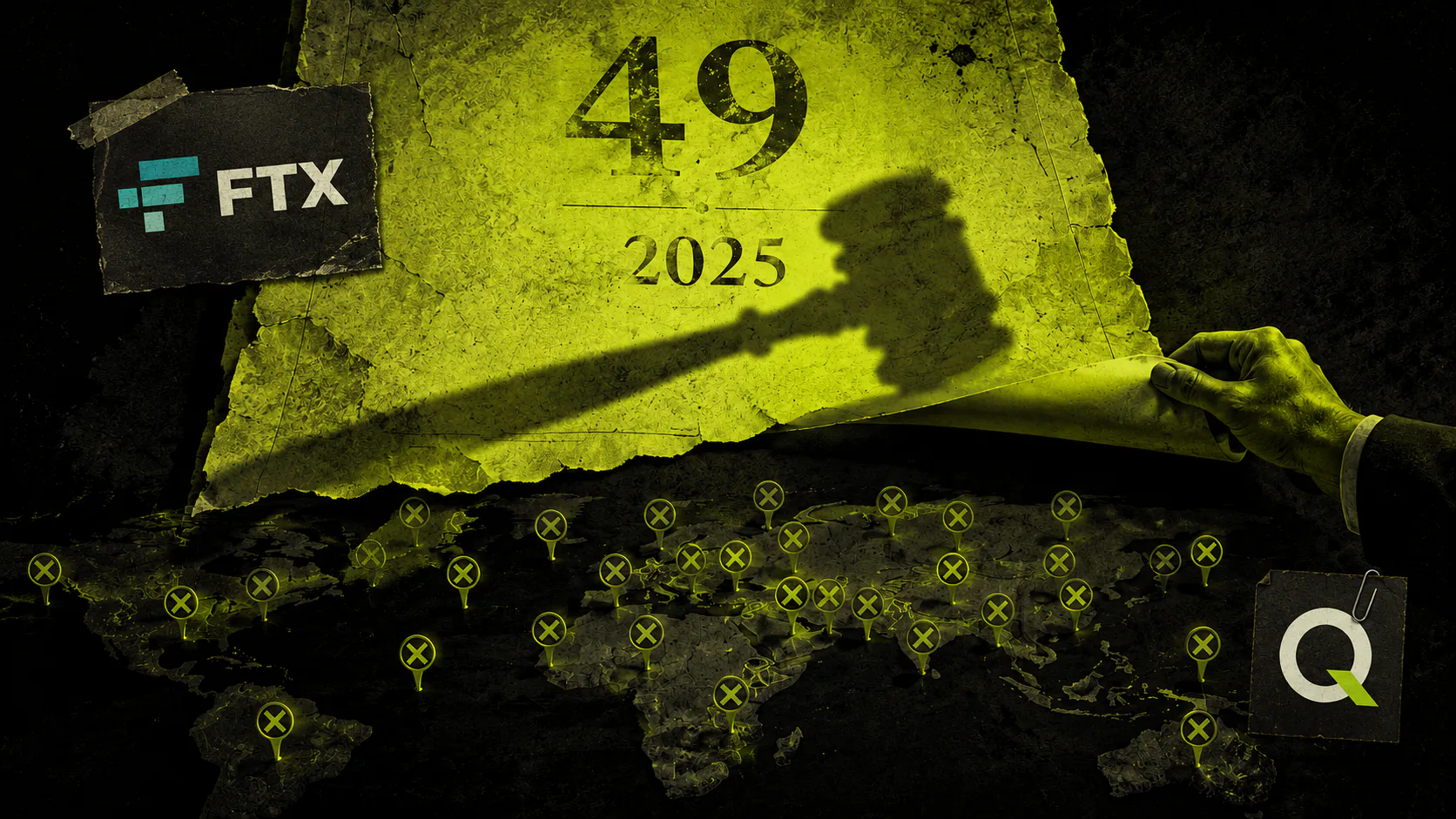
- The motion, filed 2 July 2025, listed 49 jurisdictions, about 5% of the projected value of potentially allowed claims (D.I. 31148; Exhibit B).
- By the Trust's own figure, 82% of the value of affected asserted claims was in China (Motion, D.I. 31148).
- Under the proposed procedures, creditors in a listed country would have had at least 45 days after a Restricted Jurisdiction Notice to object (D.I. 31148, ¶ 13(c)(ii)).
- Objections to the motion itself were due by 15 July 2025, 4:00 p.m. ET (notice of motion, D.I. 31148).
What the Motion Actually Said
In early July 2025, the FTX Recovery Trust filed a motion asking the Delaware Bankruptcy Court for permission to establish a "Restricted Jurisdiction Procedure." The motion said the Trust had not yet confirmed whether it, or its distribution service providers, may legally pay residents of the listed countries.
“The FTX Recovery Trust shall be authorized and will consider Claims in Potentially Restricted Foreign Jurisdictions as Disputed Claims … until such time as the status of the Potentially Restricted Foreign Jurisdiction is resolved and the Claim is otherwise Allowed or disallowed.”
- Motion of the FTX Recovery Trust for Entry of an Order in Support of the Confirmed Plan Authorizing the FTX Recovery Trust to Implement the Restricted Jurisdiction Procedures in Potentially Restricted Foreign Jurisdictions, D.I. 31148, July 2, 2025
If a lawyer retained by the Trust advised against paying residents of a listed country, their claims would have been held as disputed, and unpaid, until resolved.
The motion's Exhibit B listed 49 jurisdictions, about 5% of projected allowed-claim value. By the Trust's own figure, 82% of the value of affected asserted claims was in China (D.I. 31148); Russia, Ukraine and Belarus were also on the list.
View jurisdictions not currently eligible for distribution
As of October 30, 2026, FTX lists these jurisdictions as not eligible for distributions - residents cannot select a Distribution Service Provider (BitGo, Kraken, Payoneer) in the FTX Customer Portal. Source: FTX Support.
Afghanistan · Algeria · Bangladesh · Belarus · Burundi · Cambodia · Cameroon · Central African Republic · Chad · China · Colombia · Congo (Democratic Republic) · Congo (Republic) · Cuba · Egypt · Equatorial Guinea · Ethiopia · Fiji · Gabon · Honduras · Iran · Iraq · Kuwait · Lebanon · Lesotho · Libya · Macau · Malawi · Maldives · Moldova · Morocco · Myanmar (Burma) · Nepal · North Korea · Qatar · Russia · Saudi Arabia · Somalia · Sudan · Syria · Tunisia · five regions of Ukraine (Crimea, Donetsk, Luhansk, Zaporizhzhia and Kherson) · Western Sahara
This is an operational DSP limitation, not in itself a forfeiture of your claim. But FTX has warned that a holder who does not onboard with a distribution provider within six months of July 31, 2026 (around January 31, 2027) may forfeit distributions on the claim. The restriction follows the holder's residency - selling to a buyer outside these jurisdictions remains a valid route. FTX states it continues to assess eligible jurisdictions, and the list may be updated.
Under the proposed procedure, after adverse legal advice or a regulator's notice, creditors would get at least 45 days to object; only then could distributions to residents of a designated country revert to the Trust. That prospect caused mass panic.
What "Withdrawn Without Prejudice" Means for Restricted Jurisdictions
The Trust withdrew the motion "without prejudice" - legal language meaning they reserve the right to refile. This is not the same as a permanent victory for creditors.
“PLEASE TAKE FURTHER NOTICE that if and when the FTX Recovery Trust seeks to renew the relief requested in the Motion, the FTX Recovery Trust shall file a motion and provide notice in accordance with the applicable rules.”
- The FTX Recovery Trust's Notice of Withdrawal of Motion to Implement the Restricted Jurisdiction Procedures in Potentially Restricted Foreign Jurisdictions, D.I. 33439, November 3, 2025
The Trust can revive the request only by filing a new motion and giving notice under the court's rules.
In practice, it means the Trust will handle restricted jurisdiction cases individually rather than through a blanket procedure. If they can find a compliant way to pay you, they will. If they genuinely cannot - for example, a creditor on the OFAC SDN list - they can still freeze that specific claim.
But the mass forfeiture risk from that motion is gone. For the vast majority of Russian, Ukrainian, and Belarusian creditors who are not personally sanctioned, the withdrawal means their claims are still valid and payable - subject to FTX's separate warning that a holder who does not onboard with a distribution provider within six months of July 31, 2026 may forfeit distributions on the claim.
Restricted Jurisdictions - Current Status by Country (May 2026)
| Country | Motion Status | Practical Reality |
|---|---|---|
| Russia | Withdrawn | Claims valid. Russia is on FTX's list of jurisdictions without payouts; no provider can be selected. Selling is the practical way out. |
| Belarus | Withdrawn | EU ban on crypto-asset services in force since Aug 25, 2026. Selling recommended. |
| Ukraine / China | Motion withdrawn, still listed | As of October 30, 2026, FTX's DSP page lists China and five regions of Ukraine (Crimea, Donetsk, Luhansk, Zaporizhzhia and Kherson) as not eligible for distributions; residents there cannot select a provider. Since October 30, 2026, according to the FTX list, creditors in Ukraine, except in five regions (Crimea, Donetsk, Luhansk, Zaporizhzhia and Kherson), can select a payout provider in the FTX Customer Claims Portal. The provider makes the final onboarding decision. For residents of China and the five regions, selling remains the practical route. |
| Iran / Cuba / DPRK | Still blocked | OFAC primary sanctions - no workaround exists. Claims effectively unrecoverable. |
The Real Problem with Restricted Jurisdictions: Infrastructure, Not Law
For the country-specific process, see FTX distribution restrictions in China. Our separate guide explains FTX payout restrictions across Arab countries and the differences between countries in the region.
The motion being withdrawn doesn't mean a Russian creditor can now easily select BitGo or Kraken and receive a wire to their Sberbank account. The legal right to receive payment was restored. The practical infrastructure to deliver that payment is a separate problem.
BitGo operates under US regulations. Kraken is a US-registered exchange. Payoneer has its own compliance requirements. None of them will onboard a customer with a Russian or Belarusian bank account in 2026.
This is why the secondary market exists. The claim is legally yours and legally transferable. The new holder passes its own KYC and receives distributions under the rules for its own country.
Passport vs. Residence: The Key Distinction
One of the most important - and most misunderstood - facts about the restriction: it is based on verified residence, not passport nationality.
A Russian citizen who has moved to Georgia, UAE, Turkey, or Kazakhstan can update their jurisdiction with FTX. Once FTX verifies the new residence, the restriction lifts and distribution provider options for that country become available.
How to update your residence:
- Email kyc-support@ftx.com from your registered email address with the subject "Jurisdiction Update Request" and your claim number
- Do not attach documents to the email - FTX asks customers to upload them through the KYC page of the claims portal
- When requested, upload your residence permit for the new country
- When requested, upload a utility bill or bank statement dated within the last 3 months (FTX requirement)
FTX does not state how long processing takes. After the update, you can select a DSP available in your new country and proceed normally.
If You Can't Update Your Residence - Selling Despite Restricted Jurisdictions
Can you sell if your country has no FTX payout provider? Yes. A claim is a right to distributions from the FTX Recovery Trust, and it can be sold: the country restriction follows the holder, not the claim, and a transfer under Bankruptcy Rule 3001(e) does not depend on the seller's country. The exception is when sanctions prohibit the deal. Qredax buys such claims: here is how the sale works, step by step. More in the guide to countries without a payout provider.
For creditors who are physically in Russia or Belarus and don't have foreign residency documents, selling the claim is the most practical path.
The mechanics: the claim is transferred to Qredax via a Sale and Assignment of Claim agreement under Federal Rule of Bankruptcy Procedure 3001(e). Qredax becomes the new holder of record. It has no connection to Russia or Belarus. It selects BitGo or Kraken as its DSP. It receives the distribution. Qredax pays when the SAC is signed; the transfer becomes final after it is registered.
The restriction disappears at the moment the transfer is recorded on the Kroll register - because the restriction was attached to you as the holder, not to the claim itself.
Belarus: The Hardest Case
Belarus deserves special attention because it faces a double restriction: the FTX jurisdiction issue plus EU sanctions on crypto services.
Since March 26, 2025, Belarusian nationals and residents may not own or control EU firms providing crypto wallet, account or custody services, and a July 2026 EU regulation extends this to all crypto-asset service providers from August 25, 2026. Separately, since October 2025 it has been prohibited to provide crypto-asset services to Belarusian nationals and residents (Article 1u(2) of Regulation 765/2006); nationals of EU or EEA countries and Switzerland, and people holding a residence permit there, are exempt (Article 1u(4)). So even after the FTX motion withdrawal, crypto-asset service providers in the EU may not serve a creditor who is a Belarusian national or resident, unless that exemption applies.
For Belarus creditors, the options are:
- Foreign residency proof (Poland, Lithuania, Czech Republic, Georgia) - update your jurisdiction with FTX, proceed normally
- Sell to Qredax - fastest and cleanest, payment in USDT with no sanctions exposure
- Manual wire via BitGo to a bank in Kazakhstan or UAE - possible in theory, rarely approved in practice
What Happens If You Do Nothing
If you're in a restricted country and take no action, your claim sits in limbo. It is not forfeited through the withdrawn motion. But FTX has warned that a holder who does not onboard with a distribution provider within six months of July 31, 2026 may forfeit distributions on the claim, and you won't receive anything until you either update your residence or sell.
The FTX distribution schedule is projected to continue into 2027. Waiting is an option, but it carries two risks: the Trust could refile a restricted jurisdiction procedure (they withdrew "without prejudice"), and your claim continues to not generate any cash. If you're based in Russia, our full guide to FTX payouts for Russia covers what actually works.
Check what your claim is worth
Enter your customer code: we will show an estimate that accounts for class and KYC status. Free, no obligation.
Open the calculatorFAQ
The withdrawal of restricted jurisdictions designation does not change FTX KYC posture toward CIS-issued documents. It removes the legal blocker but leaves the operational one. For practical purposes, claim holders in originally-listed jurisdictions still face the same KYC verification challenges - restricted jurisdictions are no longer a legal barrier, but they remain a practical one.
Your claim isn't forfeited. But waiting has risks.
Get a firm price on your FTX claim, typically within one business day - no obligation to accept.
Sell your FTX claim