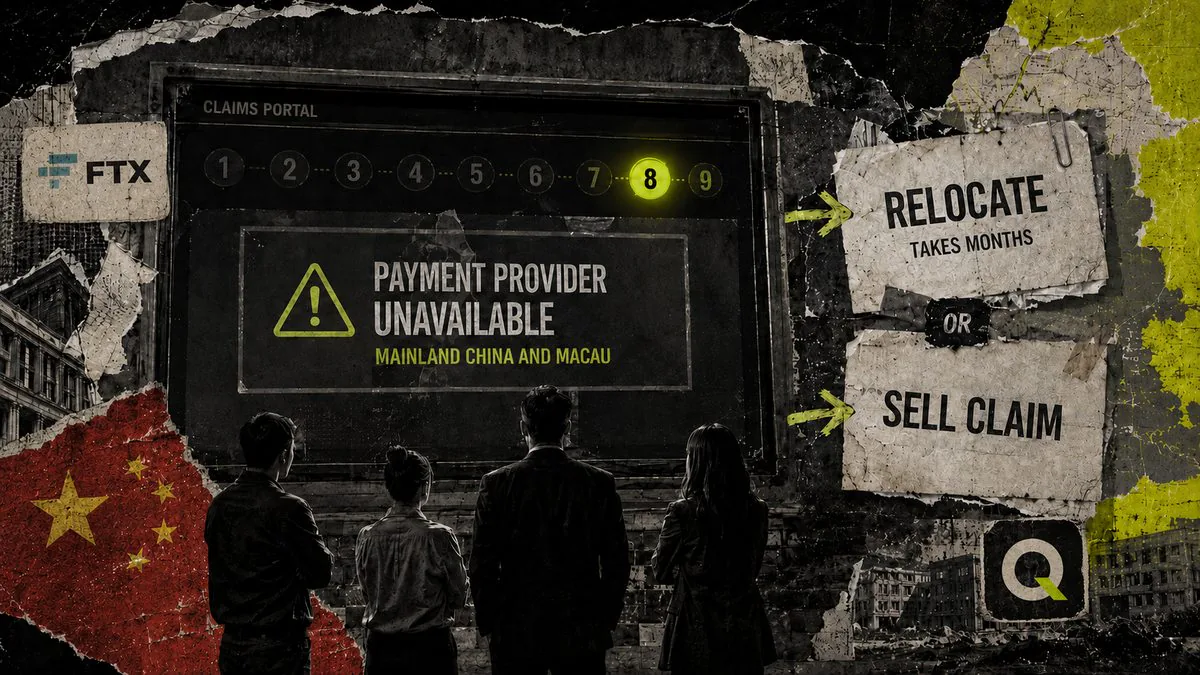
Chinese creditors hold the largest blocked position in the entire FTX bankruptcy. When the FTX Recovery Trust asked a Delaware court in July 2025 for permission to withhold payouts from 49 jurisdictions, China accounted for roughly 82% of the value at stake. Every other country on that list combined made up the rest.
That motion was withdrawn. The block did not disappear. It moved.
This guide explains what happened in 2025, exactly where the process breaks today, the two ways out of it, and what each one costs you in time you may not have.
Key facts
- In its 2 July 2025 motion, the Trust said 82% of the value of affected asserted claims in potentially restricted jurisdictions was in China (Motion, D.I. 31148).
- The same motion listed 49 jurisdictions, representing about 5% of the projected value of potentially allowed claims (Motion, D.I. 31148).
- After a court hearing on 23 October 2025, the Trust filed notice withdrawing the motion (Notice of Withdrawal, D.I. 33439, 3 Nov 2025).
- As of 1 October 2026, FTX lists China and Macau, but not Hong Kong, among jurisdictions whose residents cannot select a provider (FTX DSP page, updated 2 Oct 2026).
- FTX says holders who do not onboard with a provider within six months of the 31 July 2026 distribution date may forfeit their distributions (Distributions Dashboard FAQs, updated 13 Sept 2026).
- On 6 February 2026, the People's Bank of China and seven other agencies issued Yinfa [2026] No. 42, repealing the 2021 crypto notice No. 237 (Notice, CSRC copy, in Chinese).
What Happened in 2025
In early July 2025 the FTX Recovery Trust filed a motion asking the Delaware Bankruptcy Court to establish a "Restricted Jurisdiction Procedure." The argument was that paying creditors in countries with restrictive crypto rules could expose the Trust and its officers to legal risk abroad.
“Distributions that cannot be made due to the illegality of doing so under the laws of a Restricted Foreign Jurisdiction will not be made and any interest in such Distribution shall revest in the FTX Recovery Trust.”
— Motion of the FTX Recovery Trust for Entry of an Order in Support of the Confirmed Plan Authorizing the FTX Recovery Trust to Implement the Restricted Jurisdiction Procedures in Potentially Restricted Foreign Jurisdictions, D.I. 31148, July 2, 2025
Had the court approved this, payouts that were illegal to make in China would have gone back to the Trust instead of to creditors.
The mechanism was the alarming part. If no compliant payment route could be found for a creditor within a set period, the claim could be treated as forfeited and the money returned to the estate.
What followed was not a judgment. It was creditors organising. More than 70 formal objections reached the court, over half from Chinese claimants. The most consequential was filed by Weiwei Ji, a Chinese passport holder living in Singapore whose family held four verified accounts with claims above 15 million dollars. He filed on behalf of more than 300 Chinese creditors.
Their argument still describes your position today: FTX pays in US dollars, not crypto. Chinese law treats virtual assets as personal property. Chinese creditors had already been paid in other crypto bankruptcies. And the Trust had produced no evidence that paying dollars into China created criminal exposure for anyone.
On November 3, 2025, the Trust withdrew the motion. Without prejudice. It gave up nothing permanently and kept the right to raise the question again.
Where the Payout Actually Breaks
The court stepped back. The payment providers did not.
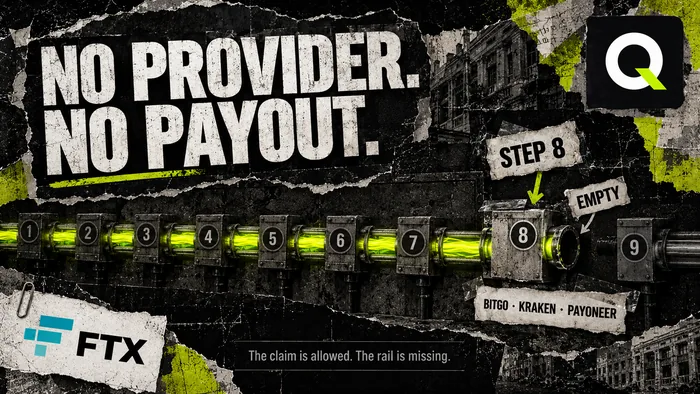
Distributions reach creditors through three approved Distribution Service Providers: BitGo, Kraken and Payoneer. Each runs its own compliance and decides which jurisdictions it will serve. The Trust does not override those decisions.
Work through the claims portal and you will find that Steps 1 through 7 go fine. Your Chinese passport passes identity verification (KYC), which the FTX Recovery Trust and its KYC vendors handle through the FTX Customer Portal. You confirm your claim, file your tax form, and everything looks normal.
Step 8 is where it stops. That is where you select a distribution provider, and for a mainland address there is nothing to select. Mainland China and Macau are both on the list of jurisdictions that cannot choose a provider.
This is the fact most creditors get wrong. The block is not your passport. It is your address. Kroll verifies who you are and accepts Chinese documents without special difficulty. The providers look at where you live.
Which means there are exactly two ways to get paid: change the address the claim is attached to, or change who holds the claim.
Route One: Change Your Jurisdiction
The list of ineligible jurisdictions is not a list of nationalities. Hong Kong, for instance, is not on it, and the providers onboard Hong Kong residents. So do Singapore, Japan, the UAE and most of the world.
“The Distribution Service Provider options shown to you are based on the residence information you previously provided.”
— General Information on Distribution Service Providers, October 2, 2026
Providers are offered by country of residence, not passport, so a Chinese citizen living in a served country can see options at Step 8.
If you can establish genuine residence somewhere supported, Step 8 opens.
The word doing the work there is genuine. This is not a matter of using an address. It means real residence status, a local address you can evidence with documents, a bank relationship in that jurisdiction, and then emailing [email protected] with the new residence documents so that, after review, the FTX Recovery Trust updates your jurisdiction (you may then need to re-onboard with the provider). A stamp in a passport does not do it, and declaring an address you do not live at is a misrepresentation inside a US federal bankruptcy proceeding. The risk lands on the claim.
Now count the time.
| Stage | Realistic duration |
|---|---|
| Obtain residence status | Weeks to months, depending on the programme |
| Open a local bank account | Weeks, with in-person requirements in most places |
| Assemble address evidence dated within 60 days | Days, once you actually live there |
| Claims agent updates your jurisdiction | Two to four weeks after submission |
| Provider onboarding and its own compliance | Weeks, and it can still decline |
Add those up honestly. For someone starting today with no existing foreign status, the total is measured in months, not weeks. And each stage can stall on something outside your control.
Against a deadline in January 2027, that is not a comfortable runway. It is doable if you already have a foreign status, a foreign account, or a live application in progress. If you are starting from zero, it is a race.
Route Two: Sell the Claim
The second way to get paid is to stop being the one who has to collect.
A claim sale transfers your legal right to future distributions to a buyer who can actually receive them. It runs on a written contract called a Sale and Assignment of Claim, followed by a Notice of Transfer of Claim filed on the public Chapter 11 docket under Federal Rule of Bankruptcy Procedure 3001(e). Kroll, the claims agent, then validates the transfer and notifies both parties, which starts the 21-day period to dispute it, and the buyer becomes the holder of record.
The mechanism does not care where you live. The restriction attaches to the holder, not to the claim. Once the transfer is recorded, the wall at Step 8 stops being your problem, because collecting is no longer your job.
What this removes, in order:
- The Step 8 block. You are not selecting a provider. The buyer already has one.
- The relocation project. No residence status, no foreign bank account, no address evidence, no waiting on the claims agent.
- The January deadline. It stops applying to you once the claim is transferred.
- The refiling risk. The Trust withdrew its motion without prejudice. If it ever comes back, it comes back at whoever holds the claim then.
- Every future distribution's paperwork. Remaining payouts run into 2027 and beyond, each with its own record date and onboarding requirement.
Two points that matter specifically for a Chinese seller:
Your name is normally withheld from the public filing. In the public transfer notices we reviewed, the seller's name was withheld or redacted, and the claims agent holds the unredacted version internally. A redacted name is not a guarantee that nobody can connect the filing with information from another source.
Settlement terms are agreed case by case. How and where funds are received depends on your situation and your jurisdiction. That gets worked out before anything is signed, not after.
Comparing the Two Honestly
Neither route is free, and neither is right for everyone.
| Change jurisdiction | Sell the claim | |
|---|---|---|
| What you end up with | The full remaining recovery | A fixed amount, agreed in writing |
| Time to resolution | Months, with stages outside your control | The sale process, then done |
| What can go wrong | Any stage stalls; provider can still decline | You review the contract before signing |
| Who carries the deadline | You | The buyer |
| Who carries the refiling risk | You | The buyer |
| Cost | Relocation, banking, time, uncertainty | The discount to face value |
If you already hold foreign residence or have a serious application underway, the first route captures more and you should finish it. If you are starting from nothing, in mainland China, with five months on the clock, the honest arithmetic points the other way.
Your Claim Is Not Cryptocurrency
This is the question that stops many Chinese creditors before they consider either route, so here is a direct answer.
On February 6, 2026, the People's Bank of China and seven other departments issued Notice No. 42, repealing the 2021 Notice No. 237 that had governed the area. The line stayed strict: virtual currencies are not legal tender, domestic virtual currency business is illegal financial activity, and civil acts built on crypto investment are void with losses borne by the investor.
None of that describes an FTX claim.
An allowed claim in the FTX bankruptcy is a US dollar debt owed by a US estate, fixed at the value of your holdings on November 11, 2022. Whatever you held on the exchange became a dollar figure on that date and has been a dollar figure ever since. The Trust pays dollars. It does not pay tokens.
That distinction is exactly what the Chinese objection group argued in 2025. Selling that claim is the assignment of a debt, not a virtual currency transaction.
The practical questions, how funds are received and through which account, have answers that depend on your own situation. They are worth putting to a licensed PRC lawyer before you act rather than after.
The Clock
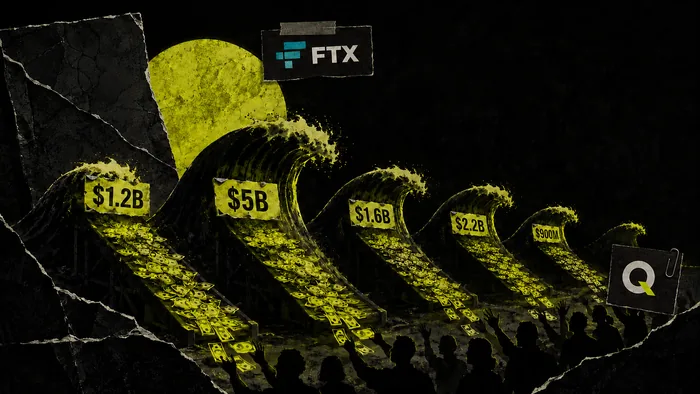
The fifth distribution began on July 31, 2026, sending around 900 million dollars to creditors and bringing total payouts to more than $10 billion since early 2025.
Cumulative recovery now sits above the face value of the claims. Class 5A, the Dotcom customer class most Chinese creditors hold, has been paid 105% of allowed amounts. Class 5B is also at 105%, Classes 6A and 6B at 103%, Class 7 at 120%.
If none of that reached you, you are not alone. Those numbers describe creditors who cleared Step 8.
FTX Support puts it plainly: if the holder of an allowed claim does not successfully onboard with a distribution service provider (Step 8) within six months of the July 31, 2026 distribution date, that holder may forfeit the right to receive distributions on their allowed claims. The plural is in the source. The published wording is not confined to the single payment you missed, and it does not say where the consequence stops.
The fifth distribution commenced July 31, 2026. That window closes at the end of January 2027.
Undelivered amounts return to the estate and are redistributed among creditors who did complete the process. The money does not wait.
FTX's guidance says that where no provider can serve a jurisdiction, the distribution is deferred to a later date; it does not say how the six-month onboarding rule applies to such holders. The wording is may forfeit, which leaves the decision with the Trust. Whether it has ever been applied to someone blocked by jurisdiction is not known: there is no precedent either way.
Why Qredax
We are not the largest buyer in this market and do not claim to be. What we do differently matters more for a Chinese creditor than size does.
We work in Chinese. This site, this article, and the person who answers your message. Most institutional claim buyers operate in English and deal with funds, not individuals. If you have tried to get a straight answer about your claim in your own language, you know how rare that is.
We take the claims other buyers decline. KYC stuck in review. A restricted jurisdiction. A disputed or expunged claim. These get quiet rejections elsewhere. They are the ones we assess seriously.
We reply within one business day. Not "we will be in touch."
Everything is verifiable before you commit. A written SAC your own lawyer reviews before you sign. No upfront payment of any kind. Every completed transfer is recorded on the public bankruptcy docket, an independent record neither of us controls.
You do not have to trust us. You have to be able to check us, and the structure is built so that you can.
Check what your claim is worth
Enter your customer code - we will show an estimate that accounts for class and KYC status. Free, no obligation.
Open the calculatorStuck at Step 8? Send us the claim.
Your Kroll customer code, your claim class, and your jurisdiction is all it takes. We reply within one business day with a firm assessment. An NDA covers your documents before you share anything, and there is no obligation to accept.
Get a Quote