On July 24, 2026, Chief Judge Karen B. Owens of the US Bankruptcy Court for the District of Delaware ruled on a motion to dismiss in adversary proceeding 24-50222. The plaintiffs are the FTX Recovery Trust and FTX Digital Markets, Ltd.
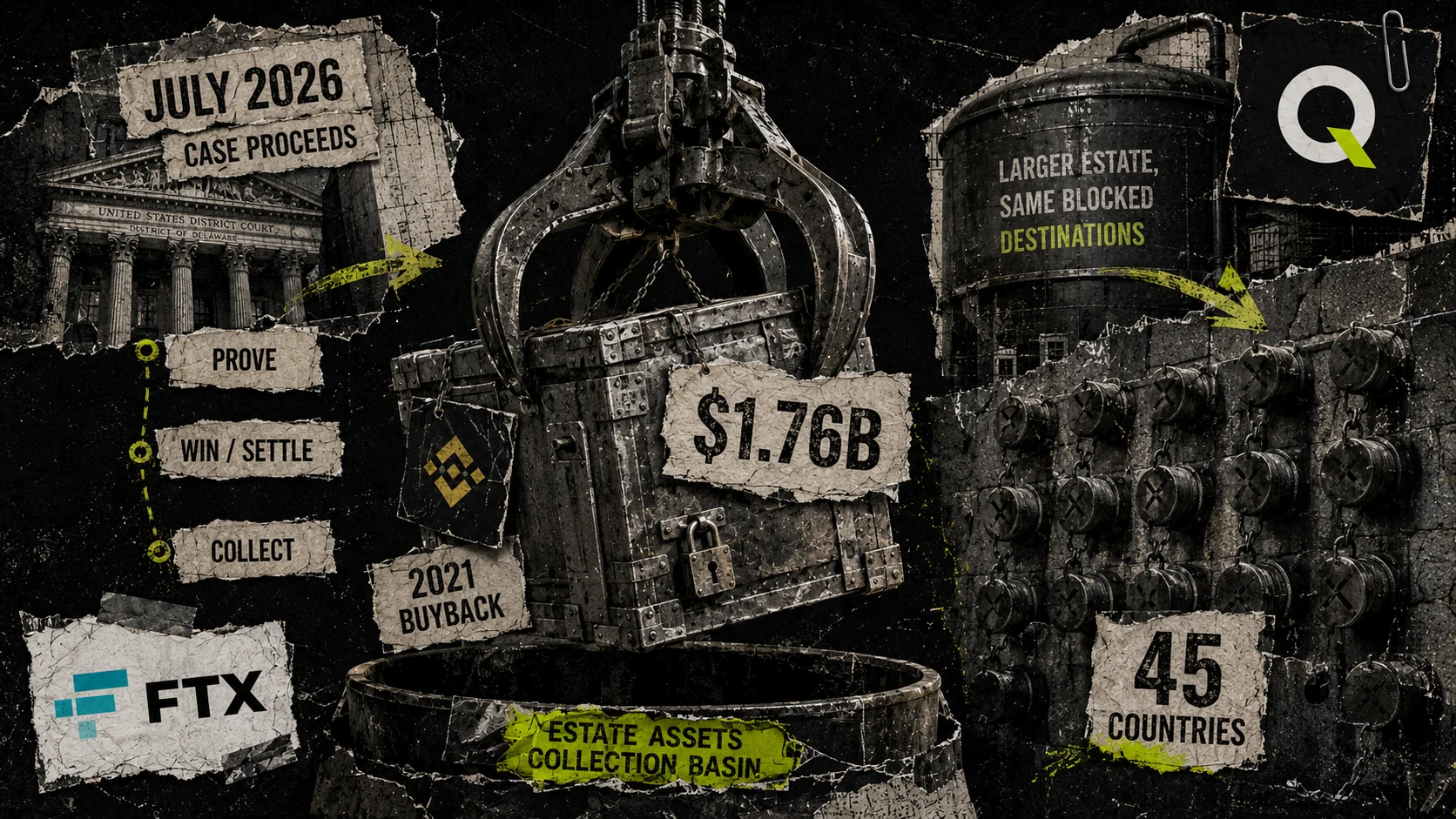
The result was split. The Trust lost its damages claims tied to the November 2022 collapse. It kept the part that matters most: the attempt to recover $1.76 billion paid to Binance parties in a 2021 share repurchase.
That figure is the largest single recovery still open in this bankruptcy. It is also widely misreported. This guide covers what the court actually decided, what it did not, and what a larger estate means for a creditor who cannot receive a distribution in the first place.
Key facts
- On 24 July 2026, Chief Judge Karen B. Owens refused to dismiss the fraudulent-transfer Counts I to V against the Binance entities and Changpeng Zhao (Opinion and Order, Adv. Pro. No. 24-50222).
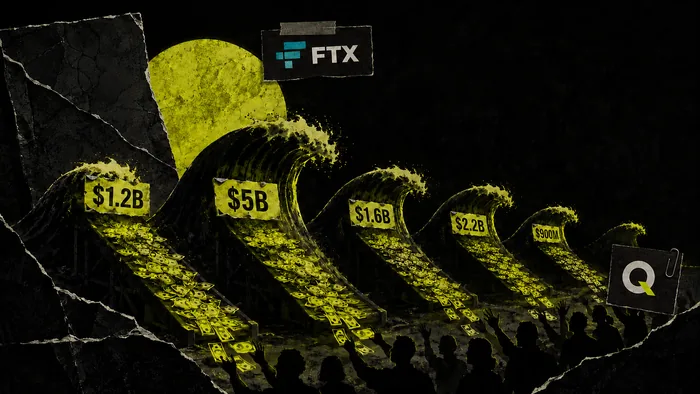
- The plaintiffs' complaint, dated 10 November 2024, says the tokens paid in the July 2021 buy-back had a fair market value of at least $1.76 billion (Complaint, Adv. Pro. No. 24-50222).
- The 24 July 2026 order dismissed Counts VI to IX, the damages claims over Binance's and Zhao's tweets, under the in pari delicto doctrine (Opinion and Order).
- The court's summary of the complaint says Binance and Zhao bought a 20% stake in FTX Trading in 2019 for $18.3 million (Opinion and Order).
What the Court Decided
Binance and Changpeng Zhao asked the court to throw the case out entirely. The court refused, in part.
“For these reasons, the Court concludes that the State Law Claims are barred by the doctrine of in pari delicto. The Motions with respect to these claims will therefore be granted.”
— Chief Judge Karen B. Owens, Opinion and Order Regarding Defendants' Motions to Dismiss the Complaint, Adv. Pro. No. 24-50222, July 24, 2026
For creditors, only the clawback claims (Counts I to V) can still add money to the estate; the damages claims over Binance's and Zhao's tweets are gone.
Counts I through V survive. These assert constructive and actual fraudulent transfer and seek recovery of the transferred property or its value. They proceed against four Binance entities - Binance Holdings Limited; Binance Capital Management, now Digital Anchor Holdings Limited; Binance Holdings (IE) Limited; and Binance (Services) Holdings Limited - and against Zhao personally.
Counts VI through IX were dismissed. These covered injurious falsehood, fraud, intentional misrepresentation and unjust enrichment, all tied to statements around FTX's collapse. The court applied in pari delicto - the doctrine barring a wrongdoer's estate from suing over harm its own conduct caused - and rejected the plaintiffs' adverse interest exception, finding that the alleged facts support the sole actor exception to it.
Claims against two individuals were dropped. Dinghua Xiao and Samuel Wenjun Lim are out of the clawback counts.
The court also found it had bankruptcy jurisdiction, declined to send the dispute to arbitration, and refused to dismiss under the safe harbour provision in the Bankruptcy Code because that defence had not been established at this stage.
Two questions were left open, and both matter for whether money ever moves. The court deferred a final decision on which law applies. On extraterritoriality - how far US bankruptcy law reaches over transfers and parties abroad - it concluded, for this stage of the case, that the Transfer occurred domestically and refused to dismiss on that ground; where the Transfer took place can be revisited after discovery.
Where the $1.76 Billion Comes From
The claim goes back to July 2021, before the collapse and before most people had reason to think about either company's balance sheet.
Binance held roughly 20% of FTX Trading. Binance and Changpeng Zhao, along with Binance executives Dinghua Xiao and Wenjun Lim, acquired a further 18.4% stake in West Realm Shires, the entity behind FTX.US. Seven agreements executed on July 15, 2021 repurchased those stakes.
FTX did not pay in dollars. The consideration was BUSD, BNB and FTT - Binance's own stablecoin, Binance's exchange token, and FTX's exchange token.
The Trust alleges those assets were worth at least $1.76 billion, that FTX was already insolvent when it made the transfers, and that the money used was not FTX's to spend.
That valuation is the plaintiffs' allegation, not a finding. The court has not put a number on the transfer, and the eventual figure - if there is one - could differ.
Two things get lost when this number travels. Headlines round it to $1.8 billion; the complaint and the ruling both say $1.76 billion. And the sum is routinely described as though it were awarded or owed, when it is neither. It is what one side says the transferred assets were worth.
Why This Is Not Money in the Estate
Headlines describing this as a $1.76 billion recovery skip the part that matters. Between a surviving claim and cash in the estate sit four separate hurdles.
“Whether further developed facts and briefing on this issue will support the same finding remains unknown but for now, dismissal of the Plaintiffs' avoidance and recovery claims based on a theory of impermissible extraterritorial application will be denied.”
— Chief Judge Karen B. Owens, Opinion and Order Regarding Defendants' Motions to Dismiss the Complaint, Adv. Pro. No. 24-50222, July 24, 2026
For creditors, the clawback claims passed the extraterritoriality defence only for now; later facts could change that, so no recovery is assured.
Proving the claims. Fraudulent transfer requires showing specific things about FTX's condition and intent in July 2021. A court letting you try is not a court agreeing with you.
Surviving the defences. Several defences the court declined to resolve now can return on a fuller record. The safe harbour argument was rejected because it had not been established at the pleading stage, not because it was found to be wrong.
Winning or settling. Cases this size usually end in settlement, and settlements land below the number in the complaint.
Collecting. A judgment against entities and an individual spread across multiple jurisdictions is a different problem from a judgment on paper.
Each step takes time. None of them is guaranteed, and the case has already been running since the original complaint was filed in November 2024.
What a Bigger Estate Actually Changes
Suppose the Trust wins the whole amount. What happens then?
The recovered money goes into the estate and is distributed to creditors under the plan, class by class, in the same proportions as everything else. It would be paid out in a later distribution round, on a record date announced in advance, through the same three payment providers.
Which means the effect on any individual creditor depends entirely on one thing: whether that creditor can receive a distribution at all.
Cumulative recovery for Class 5A already stands at 105% of allowed amounts. More than $10 billion has been distributed since February 2025. For a creditor in an accessible jurisdiction with a cleared identity check, a further recovery is straightforwardly good news - a bigger number, paid the same way as the rest.
For a creditor who cannot select a payment provider, it changes nothing at all.
The Part That Does Not Make Headlines
FTX publishes a list of jurisdictions whose residents cannot select a distribution provider. As of October 1, 2026 it runs to 44 entries, and it includes Russia, Belarus, Ukraine, China, Macau, Moldova, Egypt, Saudi Arabia, Iraq, Lebanon and more.
Creditors in those places are not disputed and not disqualified. Their claims are valid and their recovery is accruing. The process simply stops at Step 8 of the claims portal, where you choose how the money reaches you and there is nothing to choose.
So a larger estate raises the amount those holders cannot collect. The 105% figure already describes money they have not seen. Adding $1.76 billion to the pool adds to a number that is not reaching them.
That is the honest reading of this ruling for anyone in that position. It is good news for the estate. Whether it is good news for you depends on a question the estate does not answer.
What This Changes for Your Decision
If you are weighing whether to wait or sell, this ruling is worth about as much as the odds you assign to it.
If you can collect, it is a real if uncertain addition to the wait-and-hold case. More recovery, on the same timeline, through the same route that already works for you.
If you cannot collect, it is a larger number behind the same closed door. The clawback case does not touch the payment layer, the jurisdiction list, or the identity check. Those are decided by the payment providers and their own compliance, not by a bankruptcy judge in Delaware.
There is also a timing point worth naming. Litigation of this size runs for years. Any money it produces would arrive in a distribution round well after the ones already scheduled - and the plan's onboarding requirements would apply to that round the same way they apply to the ones before it.
Two Routes, Unchanged
For a creditor who cannot receive a distribution, this ruling does not open a new path. The two that existed before it are the two that exist after.
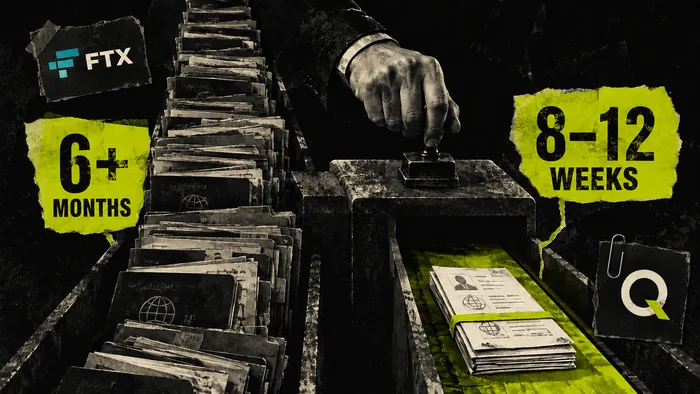
Establish residence somewhere supported. The restriction follows the address, not the passport. Genuine residence in a jurisdiction the providers serve reopens Step 8. It takes months and it is not available to everyone.
Sell the claim. A transfer under Federal Rule of Bankruptcy Procedure 3001(e) moves the claim to a holder who can collect. A recorded transfer changes who receives distributions, but FTX still requires the original holder of the claim to have passed KYC by the distribution record date. Any future recovery from the Binance case would then belong to the buyer, priced into the offer today.
Neither is affected by what happens in the Binance litigation. That is the point: the case changes the size of the pool, not who can reach it.
Check what your claim is worth
Enter your customer code - we will show an estimate that accounts for class and KYC status. Free, no obligation.
Open the calculatorStuck at Step 8? Send us the claim.
Your Kroll customer code, your claim class, and your jurisdiction is all it takes. We reply within one business day with a firm assessment. An NDA covers your documents before you share anything, and there is no obligation to accept.
Get a Quote